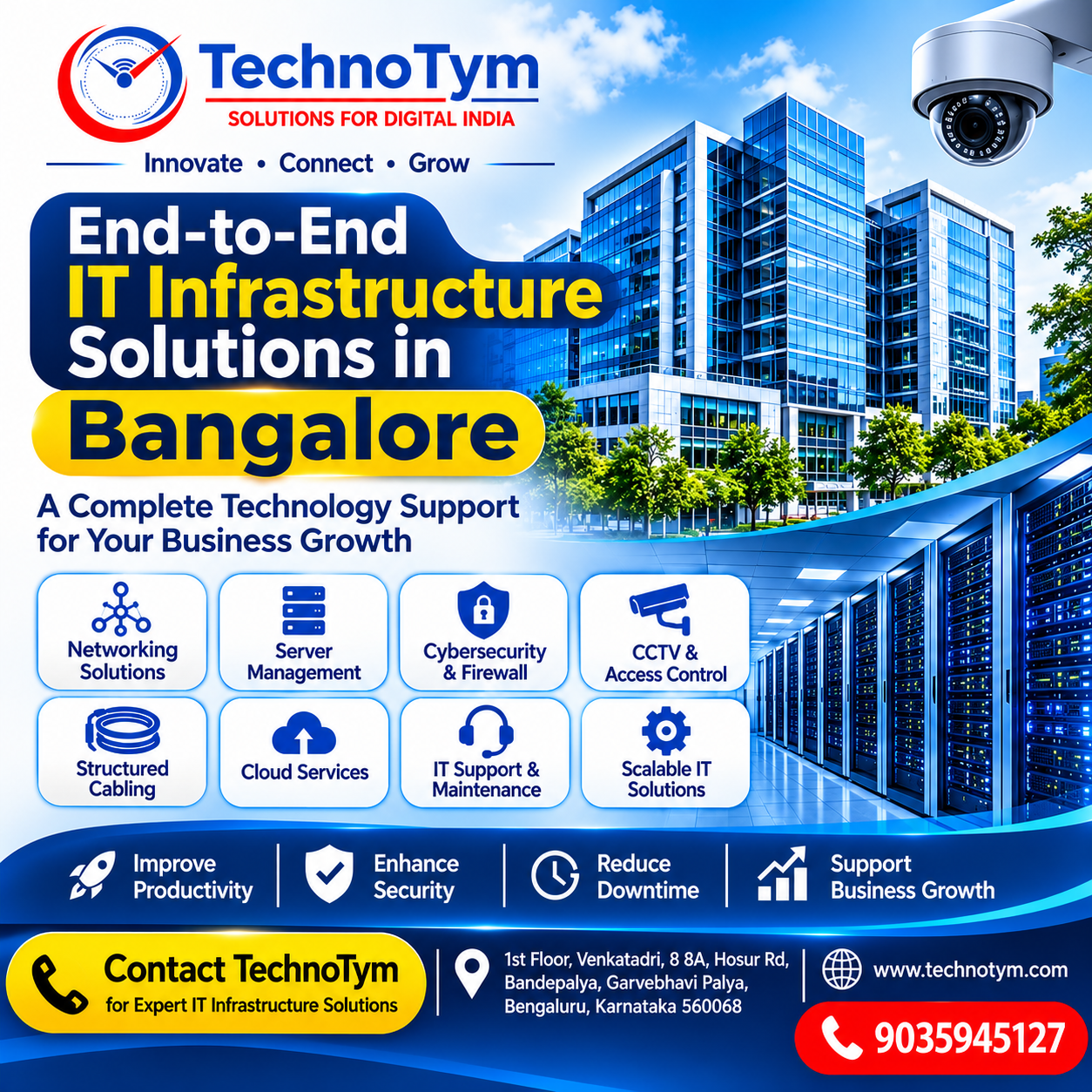
End-to-End IT Infrastructure Solutions in Bangalore: A Complete Guide for Growing Businesses
Technology has become the backbone of modern business operations. From communication and data management to cybersecurity and customer services, every organization depends on a reliable IT infrastructure to operate efficiently.
For businesses in Bangalore, maintaining a strong technology environment is essential to remain competitive and support continuous growth.
However, managing networking, servers, security systems, business applications, and technical support through different service providers can become complicated.
This is where End-to-End IT Infrastructure Solutions in Bangalore become valuable. They help businesses plan, implement, manage, and maintain their technology requirements through a coordinated approach.
What Are End-to-End IT Infrastructure Solutions?
End-to-end IT infrastructure solutions cover the complete technology environment required to operate a business.
These services may include IT consultation, network installation, server management, structured cabling, cybersecurity, CCTV surveillance, access control, cloud services, and technical support.
The main objective is to create an integrated technology environment that improves business efficiency, supports security requirements, and allows organizations to expand.
Key Components of Business IT Infrastructure
1. IT Networking Infrastructure
Networking connects computers, servers, printers, and other business devices.
A properly designed network allows employees to communicate, access shared resources, and use business applications efficiently.
Network infrastructure generally includes:
Routers and network switches.
Wireless access points.
Structured network cabling.
Network configuration.
Firewall integration.
Network troubleshooting.
2. Server Installation and Management
Servers play an important role in storing business information, managing applications, and sharing resources.
Organizations may use physical servers, cloud servers, or hybrid infrastructure depending on their requirements.
Professional server management helps businesses maintain system performance, availability, storage management, and appropriate access controls.
3. Cybersecurity and Firewall Protection
Cybersecurity is essential for businesses that manage confidential customer information and internal business data.
Security measures can include firewall configuration, access management, endpoint protection, software updates, network segmentation, and security monitoring.
A well-planned security approach helps reduce exposure to unauthorized access and cyber threats.
4. CCTV Surveillance and Access Control
Physical security is another important part of modern business infrastructure.
CCTV surveillance systems help organizations monitor their premises, while access control systems help manage entry permissions for employees and visitors.
These solutions are useful for offices, warehouses, commercial buildings, and industrial facilities.
5. Structured Cabling and Connectivity
Structured cabling provides an organized foundation for communication and connectivity.
It supports networking devices, computers, telephone systems, and compatible surveillance equipment.
Proper installation, cable labelling, and testing make infrastructure easier to maintain and expand.
6. Cloud and Business Email Solutions
Cloud services and professional business email systems help employees communicate and collaborate.
Businesses can use cloud-based applications to access information, manage documents, and work across different locations.
Proper account management, security settings, and backup planning are important for maintaining these services.
7. IT Support and Maintenance
Installing technology is only the beginning. Regular maintenance is necessary to maintain performance and reliability.
IT support may include:
Hardware and software troubleshooting.
Network performance checks.
System updates.
Configuration backups.
IT asset management.
Technical assistance.
Infrastructure upgrades.
Why Do Businesses Need End-to-End IT Infrastructure Solutions?
1. Simplified Technology Management
Managing different IT systems through a coordinated service approach can reduce communication gaps and simplify project management.
2. Improved Business Productivity
Reliable networks, servers, and applications help employees complete their daily responsibilities with fewer technical interruptions.
3. Better Security Management
Integrating appropriate cybersecurity practices into the IT environment helps protect business information and technology resources.
4. Reduced Operational Downtime
Regular maintenance and timely troubleshooting help identify infrastructure issues and reduce avoidable disruptions.
5. Cost-Effective Infrastructure Planning
A detailed IT infrastructure plan helps businesses understand equipment requirements, installation costs, licences, maintenance expenses, and future upgrades.
6. Scalable Technology for Business Growth
As organizations grow, they need additional computers, network devices, storage, applications, and security systems.
Scalable infrastructure makes it easier to accommodate these requirements without repeatedly redesigning the entire technology environment.
How to Plan an IT Infrastructure Project
Before implementing a new IT environment, businesses should follow a systematic approach.
Step 1: Assess Existing Infrastructure
Identify existing computers, servers, network devices, applications, security systems, and technical problems.
Step 2: Understand Business Requirements
Determine the number of employees, connected devices, required applications, security needs, and future expansion plans.
Step 3: Develop an Infrastructure Plan
Prepare a clear technology plan covering networking, servers, cabling, security, and other essential systems.
Step 4: Implement and Configure Systems
Install and configure the required equipment and applications according to the approved project scope.
Step 5: Test and Verify Performance
Check network connectivity, device communication, access permissions, security configurations, and agreed system functions.
Step 6: Schedule Maintenance and Support
Maintain documentation, configuration backups, support contacts, and regular infrastructure reviews.
How to Choose an IT Infrastructure Company in Bangalore?
Choosing the right technology partner is important for achieving long-term results.
Before selecting a provider, evaluate:
Range of IT infrastructure services.
Technical knowledge and project experience.
Network and cybersecurity capabilities.
Quality of installation and configuration.
Maintenance and technical support.
Project documentation and transparency.
Ability to provide scalable solutions.
Always request a detailed proposal explaining the services, equipment, implementation process, exclusions, and ongoing costs.
Why Consider TechnoTym for Business Technology Solutions?
TechnoTym offers a range of technology services, including web development, software development, custom CRM, digital marketing, business email, payment gateway solutions, and IT-related services.
Businesses looking to improve their technology environment can discuss their requirements with TechnoTym and explore suitable solutions based on their operational needs.
Conclusion
A strong IT infrastructure is essential for maintaining business productivity, security, and operational efficiency.
From networking and server management to cybersecurity, CCTV surveillance, access control, and cloud services, every component contributes to a reliable technology environment.
Choosing End-to-End IT Infrastructure Solutions in Bangalore helps businesses organize their technology requirements, improve infrastructure management, and prepare for future expansion.
Looking to establish a new IT infrastructure or upgrade your existing business technology? Contact TechnoTym to discuss your requirements and explore the right solutions for your organization.